

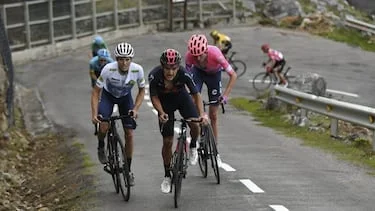
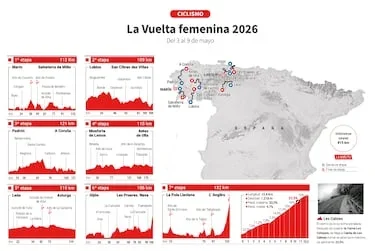
The Angliru, one of the toughest climbs in world cycling, will make its debut in La Vuelta Femenina after ten appearances in the men’s La Vuelta. This legendary “cycling hell” will decide the Spanish tour (seven stages from May 3 to 9, with no time trial) in its fourth edition under this official name.
The climb features distinct sections: Les Cabanes (22%), Llagos (14.5%), Los Picones (20%), Cobayos (21.5%), La Cueña les Cabres (23.5%), and El Aviru (21.5%), covering 12.4 km at an average gradient of 9.8%. Just writing it makes your legs ache.
On Saturday, May 9, the big day will unfold, with extra attention as the approach to the Angliru is also demanding, totaling 132 km after seven days of fatigue. Following the route presentation last Monday in Galicia, where the race starts, AS spoke to several key figures about the growth and surge of women’s cycling and the Angliru as a new milestone.
“The sport has evolved tremendously in recent years, and the riders are at an incredibly high level. We’ll see a great spectacle. We considered including the Angliru in previous years, but we believe now is the right time. We hadn’t discussed it with them before, but now we’ll provide all the information and it will be a new step. Plus, with changes in equipment and gearing for those brutal ramps, it becomes more manageable within its inherent difficulty,” explains Fernando Escartín, who was a rider in 1999 when the Asturian giant first appeared in a race, with Chava Jiménez victorious.
For Gema Pascual, women’s national team coach who secured four medals at the recent World Championships in Rwanda (one from Mavi García, one from Paula Blasi, and two from Paula Ostiz), the Angliru arrival is “proportional to the growth of women’s cycling. It was demanded, and here it is. Now it’s time to enjoy it. You can’t jump from 0 to 100, and it comes at the perfect moment. The peloton’s level is very high, and everything is well analyzed. Hopefully, a Spanish rider will write her name on this historic summit.”
Dori Ruano, ambassador of La Vuelta Femenina and a pioneer, sees this step as “a statement of intent. It will mark a turning point, and hopefully, after such a stage, people will get hooked on women’s cycling. Ramps of 24% where you have to maintain balance, with no help from teammates once the ascent begins. The strongest will win. Perico Delgado hooked me into cycling, and being a climber, I would have dreamed of a stage at the Angliru to do it like him,” says the rider from Salamanca.
Ane Santesteban recently retired from competition. “It will be a spectacular climb and will prove that women can handle anything. We are warriors, and we should be grateful to La Vuelta for such a spectacular route. Women are super-prepared for it, though I believe there’s nothing left to prove. It’s already been proven,” explains the Basque rider based in Galicia, regretting not being able to race it but not following Van der Breggen’s path out of retirement.
Sandra Alonso, who recently returned to competition after motherhood, competed last week.
