

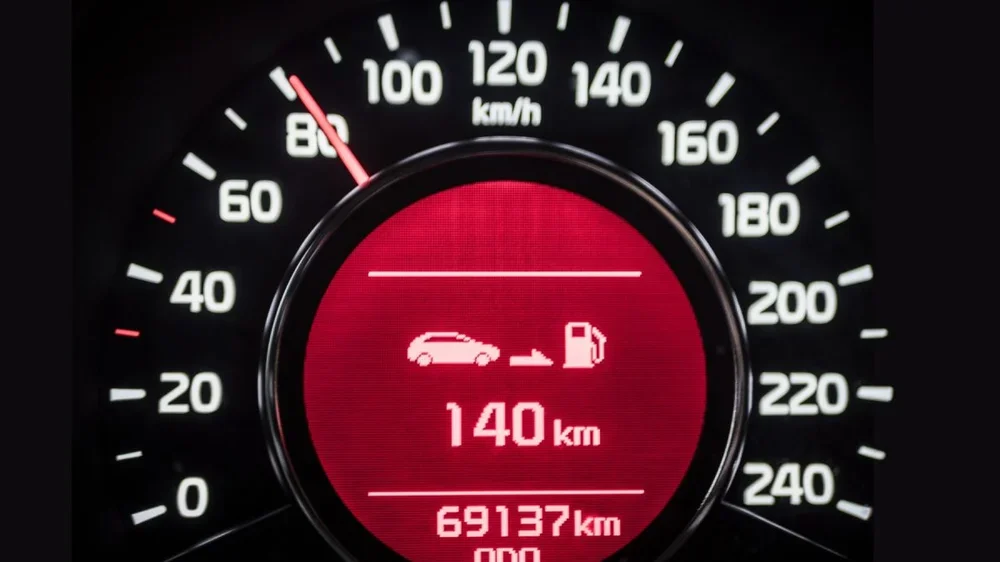
Driving efficiency has shifted from being a choice to a technical and economic necessity. With fuel prices hitting historic highs in many countries, drivers are seeking almost magical ways to stretch every tank. However, Spain’s Directorate General of Traffic (DGT) has recently reminded that the key lies not in miracle additives but in pure physics and the speedometer. There is a speed range where the engine operates at its highest thermodynamic efficiency, enabling fuel savings of up to 50% when combined with proper driving techniques.
**The Exact Point of Efficiency**
The agency, led by Pere Navarro, has shed light on one of the most frequently asked questions: what is the optimal speed to burn less fuel? The technical answer falls within a narrow range: between 90 and 100 km/h. According to data from the DGT and entities such the Institute for Diversification and Saving of Energy (IDAE), based on their “Guide to Efficient Driving for Passenger Cars,” traveling at 90 km/h represents the ideal scenario for consumption.
The math is clear and compelling. The DGT warns that increasing speed from 100 km/h to 110 km/h raises fuel consumption by 9%. The gap becomes substantial when reaching the legal highway limit: at 120 km/h, fuel consumption surges by 30% compared to the aforementioned 90 km/h. This is primarily due to aerodynamic drag, which does not increase linearly but exponentially—the faster you try to cut through the air, the more energy (fuel) the vehicle needs to overcome that invisible force.
Beyond safety reasons, there are also consumption reasons not to drive at excessive speeds. The ideal fuel consumption occurs at 90 km/h. If you increase to 120 km/h, consumption rises by 30%. #BetterToGoSlower
**The Highway Debate: Safety vs. Savings**
Nevertheless, the recommendation of 90 km/h has sparked some debate among users of fast roads. Is it safe to drive at that speed on a highway to save fuel? The DGT is clear: driving at 90 km/h on motorways is not recommended, even though it may be legally possible. The agency’s focus for that figure is on conventional roads, where it is both the maximum allowed speed and the peak efficiency point. On highways, safety must take precedence over cents. In fact, Article 49 of the General Traffic Regulations prohibits driving at an ‘abnormally reduced speed’ without valid reason. On these roads, the legal minimum is 60 km/h; driving below that threshold is a serious offense carrying a fine of 200 euros. Fuel savings would never offset the risk of a rear-end collision or the amount of the fine.
**The Role of Gears and Torque**
For the speed to be effective, it must be accompanied by smart gear management. The fundamental principle is to always drive in the highest possible gear. Before the car reaches 50 km/h, fourth or fifth gear should already be engaged. Lower gears are designed to overcome initial inertia or tackle steep inclines, but they are sworn enemies of fuel economy. Most modern engines find their comfort zone, or peak torque, between 1,500 and 3,000 rpm. Keeping the engine in this range prevents the system from making extra efforts to regain power. In this regard, the use of
